Scene transitions
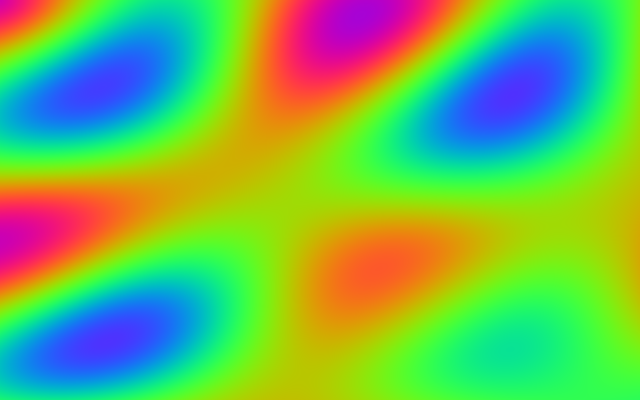
A twenty-second loop of four scenes, each a self-contained fragment-shader effect, joined by transitions that differ per scene: the plasma fades into the tunnel, the tunnel wipes into the metaballs, the metaballs dissolve into the starfield, and the starfield opens a circle back onto the plasma. Both the outgoing and the incoming scene are evaluated for every pixel and mixed by a transition mask; nothing is rendered to an intermediate texture.
; Scene transitions: a fullscreen triangle cycling through four procedural; scenes (plasma, tunnel, metaballs, starfield), each 5 s long, with a 1 s; transition into the next: fade, horizontal wipe, noise dissolve or circle; reveal, chosen by the outgoing scene. Both scenes are evaluated per pixel and; mixed by the transition mask. Driven by a pngine-inputs uniform.
(shader-module :name shader :code """    struct Uniforms {      time: f32,      width: f32,      height: f32,      aspect: f32,    }    @group(0) @binding(0) var<uniform> u: Uniforms;
    const PI: f32 = 3.14159265359;    const SCENE_DURATION: f32 = 5.0;    const TRANSITION_DURATION: f32 = 1.0;    const NUM_SCENES: u32 = 4u;
    @vertex    fn vs(@builtin(vertex_index) i: u32) -> @builtin(position) vec4f {      let x = f32(i & 1u) * 4.0 - 1.0;      let y = f32((i >> 1u) & 1u) * 4.0 - 1.0;      return vec4f(x, y, 0.0, 1.0);    }
    // Scene 0: Plasma    fn scene0(uv: vec2f, t: f32) -> vec3f {      let p = uv * 10.0;      let v1 = sin(p.x + t);      let v2 = sin(p.y + t * 0.7);      let v3 = sin(p.x + p.y + t * 0.5);      let v4 = sin(sqrt(p.x * p.x + p.y * p.y) + t);      let v = (v1 + v2 + v3 + v4) * 0.25;
      return vec3f(        sin(v * PI) * 0.5 + 0.5,        sin(v * PI + PI * 0.666) * 0.5 + 0.5,        sin(v * PI + PI * 1.333) * 0.5 + 0.5      );    }
    // Scene 1: Tunnel    fn scene1(uv: vec2f, t: f32) -> vec3f {      let centered = uv - 0.5;      let dist = length(centered);      let angle = atan2(centered.y, centered.x);
      let tunnel = fract(1.0 / (dist + 0.1) - t * 0.5);      let stripes = abs(fract(angle / PI * 4.0 + t) - 0.5) * 2.0;
      let intensity = tunnel * stripes;      return vec3f(        intensity * 0.2,        intensity * 0.8,        intensity * 1.0      );    }
    // Scene 2: Metaballs    fn scene2(uv: vec2f, t: f32) -> vec3f {      let p = (uv - 0.5) * 4.0;      var sum = 0.0;
      for (var i = 0; i < 5; i++) {        let fi = f32(i);        let center = vec2f(          sin(t * (1.0 + fi * 0.3) + fi * 1.2) * 1.5,          cos(t * (0.8 + fi * 0.2) + fi * 0.8) * 1.5        );        let d = length(p - center);        sum += 0.5 / (d + 0.1);      }
      let edge = smoothstep(1.8, 2.0, sum);      let fill = smoothstep(2.0, 2.5, sum);
      return mix(        vec3f(0.1, 0.0, 0.2),        mix(vec3f(1.0, 0.3, 0.5), vec3f(1.0, 0.9, 0.7), fill),        edge      );    }
    // Scene 3: Starfield    fn scene3(uv: vec2f, t: f32) -> vec3f {      var color = vec3f(0.0, 0.0, 0.05);
      for (var layer = 0; layer < 3; layer++) {        let fl = f32(layer);        let speed = 0.2 + fl * 0.15;        let scale = 20.0 + fl * 10.0;
        let p = uv * scale + vec2f(0.0, t * speed);        let cell = floor(p);        let local = fract(p) - 0.5;
        // Pseudo-random star position        let hash = fract(sin(dot(cell, vec2f(12.9898, 78.233))) * 43758.5453);        let starPos = vec2f(hash, fract(hash * 13.37)) - 0.5;        let d = length(local - starPos * 0.8);
        let brightness = 0.02 / (d + 0.01);        let twinkle = sin(t * 5.0 + hash * 100.0) * 0.5 + 0.5;
        color += vec3f(brightness * (0.5 + twinkle * 0.5)) * (0.3 + fl * 0.3);      }
      return min(color, vec3f(1.0));    }
    // Transition effects    fn transitionFade(progress: f32) -> f32 {      return progress;    }
    fn transitionWipe(uv: vec2f, progress: f32) -> f32 {      return step(uv.x, progress);    }
    fn transitionDissolve(uv: vec2f, progress: f32) -> f32 {      let noise = fract(sin(dot(uv * 100.0, vec2f(12.9898, 78.233))) * 43758.5453);      return step(noise, progress);    }
    fn transitionCircle(uv: vec2f, progress: f32) -> f32 {      let centered = uv - 0.5;      let dist = length(centered);      return step(dist, progress * 0.8);    }
    @fragment    fn fs(@builtin(position) pos: vec4f) -> @location(0) vec4f {      let uv = vec2f(pos.x / u.width, pos.y / u.height);      let t = u.time;
      // Calculate current and next scene      let totalCycle = SCENE_DURATION * f32(NUM_SCENES);      let cycleTime = fract(t / totalCycle) * totalCycle;
      let currentScene = u32(cycleTime / SCENE_DURATION) % NUM_SCENES;      let nextScene = (currentScene + 1u) % NUM_SCENES;
      let sceneProgress = fract(cycleTime / SCENE_DURATION);      let transitionProgress = smoothstep(        1.0 - TRANSITION_DURATION / SCENE_DURATION,        1.0,        sceneProgress      );
      // Render both scenes      var currentColor = vec3f(0.0);      var nextColor = vec3f(0.0);
      if (currentScene == 0u) { currentColor = scene0(uv, t); }      else if (currentScene == 1u) { currentColor = scene1(uv, t); }      else if (currentScene == 2u) { currentColor = scene2(uv, t); }      else { currentColor = scene3(uv, t); }
      if (nextScene == 0u) { nextColor = scene0(uv, t); }      else if (nextScene == 1u) { nextColor = scene1(uv, t); }      else if (nextScene == 2u) { nextColor = scene2(uv, t); }      else { nextColor = scene3(uv, t); }
      // Apply transition based on scene      var blend = 0.0;      if (currentScene == 0u) {        blend = transitionFade(transitionProgress);      } else if (currentScene == 1u) {        blend = transitionWipe(uv, transitionProgress);      } else if (currentScene == 2u) {        blend = transitionDissolve(uv, transitionProgress);      } else {        blend = transitionCircle(uv, transitionProgress);      }
      let color = mix(currentColor, nextColor, blend);
      return vec4f(color, 1.0);    }  """)
(render-pipeline :name pipeline  :layout auto  (vertex :module shader :entry vs)  (fragment :module shader :entry fs    (target :format preferred-canvas-format)))
(buffer :name uniforms :size 16 :usage [uniform copy-dst])
(queue :name writeUniforms  (write-buffer :buffer uniforms :offset 0 :data pngine-inputs))
(bind-group :name bindings :layout pipeline :group 0  (entry :binding 0 :buffer uniforms))
(render-pass :name mainPass  (color-attachment :view context-current-texture :clear-value [0 0 0 1] :load-op clear :store-op store)  :pipeline pipeline  :bind-groups [bindings]  (draw :vertex-count 3))
(frame :name main :perform [writeUniforms mainPass])examples/samples/29_scene_transitions.sjon in the pngine repository.
How it works
Section titled “How it works”The scaffold
Section titled “The scaffold”The SJON, the S-expression format pngine compiles (one form per WebGPU
resource or operation), is the fullscreen scaffold from
Gradient background:
one shader module, a (render-pipeline …) with :layout auto targeting the
canvas format, a 16-byte uniform buffer refilled every frame from
pngine-inputs (the built-in time/width/height/aspect source), a
bind group, a (render-pass …) drawing three vertices, and a (frame …).
The scenes, the schedule and the transitions are all WGSL, WebGPU’s shading
language, in one fragment shader.
The timeline
Section titled “The timeline”Three module constants set the schedule: SCENE_DURATION = 5,
TRANSITION_DURATION = 1, NUM_SCENES = 4. fs folds time into a
20-second cycle, derives currentScene and nextScene, and computes
transitionProgress as a smoothstep over the last second of the current
scene: 0 for the first four seconds, then rising to 1.
The scenes
Section titled “The scenes”Each scene is a function (uv, t) -> vec3f:
- Plasma: four sines, averaged, through the three-sines palette.
- Tunnel:
1 / (dist + 0.1)gives the depth into the tunnel,fractof it minus time makes rings rush inward, and stripes from the angle add spokes. - Metaballs: five moving centres contribute
0.5 / (d + 0.1)each; twosmoothstepthresholds on the sum give an outline and a fill. - Starfield: three layers of cells at increasing scale and speed, one
hashed star per cell with a
1 / dglow and a twinkle.
The transitions
Section titled “The transitions”Each returns a mask in [0, 1]: transitionFade is the progress itself,
transitionWipe is step(uv.x, progress), a vertical edge sweeping across,
transitionDissolve compares a per-pixel hash against progress so pixels
flip in random order, and transitionCircle is step(dist, 0.8 progress),
a disc growing from the centre. The final colour is
mix(currentColor, nextColor, blend). Evaluating both scenes on every
frame, even while the mask sits at 0 or 1, is a cost I accept on purpose:
on a fullscreen pass it is the simplest way to get an arbitrary per-pixel
transition without a second render target.
An exercise: raise TRANSITION_DURATION to 2.5 and recompile. Every
transition stretches with it, because transitionProgress is derived from
the three schedule constants alone.
In the specifications
Section titled “In the specifications”| What the sample uses | WebGPU | WGSL |
|---|---|---|
| Fullscreen triangle and one draw | draw() |
vertex_index, position |
| Uniform buffer, bind group | writeBuffer(), bind group creation |
uniform address space |
| Schedule and selection | const declarations, if statement, u32() conversion, integer % |
|
| Scenes | user-defined functions, for statement, fract, floor, atan2, length, min |
|
| Transitions | smoothstep, step, mix, sin, dot |
Related
Section titled “Related”- Color cycling switches patterns without a transition; Shader art (plasma) is scene 0 on its own.
- To sequence scenes from JavaScript instead, see
setFramein the JavaScript API and the(frame …)form. - Forms:
(shader-module …),(render-pass …),(queue …).