Fluid simulation
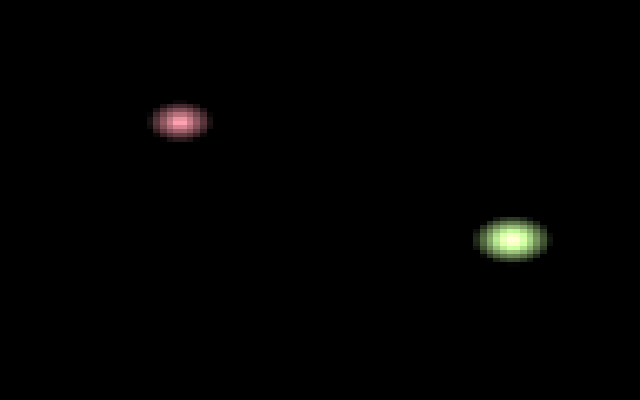
A small stable fluid. Two fields live on a 96×96 grid, a velocity (vec2f
per cell) and a dye density (f32 per cell); each frame a compute shader
advects both by looking backwards along the velocity and sampling with
bilinear interpolation, then stirs in two rotating sources. The display
colours the flow’s direction as a hue and its speed as brightness, with the
dye added on top. The poster is the first frame; press Play to see it swirl.
; Fluid simulation. A 96×96 semi-Lagrangian fluid: each frame a compute pass; traces velocity and density backward along the flow with bilinear sampling,; adds two rotating force/dye sources and damps the boundary; a fullscreen; triangle then colours velocity direction (HSV hue, speed as value) over; density brightness. Two independent `:pool 2` ping-pong fields (velocity; vec2f, density f32) give the step bind group five entries (uniforms + vel; in/out + den in/out with `:ping-pong`); `(dispatch :workgroups [6 6 1])` over a 16×16; workgroup. A compute `(init …)` zeroes the velocity field once.;; GRID_SIZE sizes the buffers only; each shader restates the extent as a local; `SIZE` constant. Keep them in step.
(define :name GRID_SIZE :value 96)
(buffer :name velocityBuffer :size (* GRID_SIZE GRID_SIZE 2 4) :usage [storage] :pool 2)
(buffer :name densityBuffer :size (* GRID_SIZE GRID_SIZE 4) :usage [storage] :pool 2)
(buffer :name uniforms :size 16 :usage [uniform copy-dst])
(queue :name writeUniforms  (write-buffer :buffer uniforms :offset 0 :data pngine-inputs))
; Zero the velocity field once.(init :name initFluid :buffer velocityBuffer :module initShader :workgroups [(ceil (/ (* GRID_SIZE GRID_SIZE) 64))])
(shader-module :name initShader :code """struct Velocity { data: array<vec2f> }struct Density { data: array<f32> }
@binding(0) @group(0) var<storage, read_write> velocity: Velocity;
const SIZE: u32 = 96u;
@compute @workgroup_size(64)fn main(@builtin(global_invocation_id) id: vec3u) {  let idx = id.x;  if (idx >= SIZE * SIZE) { return; }  velocity.data[idx] = vec2f(0.0);}""")
(shader-module :name stepShader :code """struct Uniforms {  time: f32,  width: f32,  height: f32,  aspect: f32,}@group(0) @binding(0) var<uniform> u: Uniforms;
struct Velocity { data: array<vec2f> }struct Density { data: array<f32> }
@group(0) @binding(1) var<storage, read> velIn: Velocity;@group(0) @binding(2) var<storage, read_write> velOut: Velocity;@group(0) @binding(3) var<storage, read> denIn: Density;@group(0) @binding(4) var<storage, read_write> denOut: Density;
const SIZE: u32 = 96u;const SIZEF: f32 = 96.0;const DT: f32 = 0.5;const DECAY: f32 = 0.995;
fn sampleVelBilinear(x: f32, y: f32) -> vec2f {  let x0 = clamp(i32(floor(x)), 0, i32(SIZE) - 1);  let y0 = clamp(i32(floor(y)), 0, i32(SIZE) - 1);  let x1 = min(x0 + 1, i32(SIZE) - 1);  let y1 = min(y0 + 1, i32(SIZE) - 1);
  let fx = fract(x);  let fy = fract(y);
  let v00 = velIn.data[u32(y0) * SIZE + u32(x0)];  let v10 = velIn.data[u32(y0) * SIZE + u32(x1)];  let v01 = velIn.data[u32(y1) * SIZE + u32(x0)];  let v11 = velIn.data[u32(y1) * SIZE + u32(x1)];
  return mix(mix(v00, v10, fx), mix(v01, v11, fx), fy);}
fn sampleDenBilinear(x: f32, y: f32) -> f32 {  let x0 = clamp(i32(floor(x)), 0, i32(SIZE) - 1);  let y0 = clamp(i32(floor(y)), 0, i32(SIZE) - 1);  let x1 = min(x0 + 1, i32(SIZE) - 1);  let y1 = min(y0 + 1, i32(SIZE) - 1);
  let fx = fract(x);  let fy = fract(y);
  let d00 = denIn.data[u32(y0) * SIZE + u32(x0)];  let d10 = denIn.data[u32(y0) * SIZE + u32(x1)];  let d01 = denIn.data[u32(y1) * SIZE + u32(x0)];  let d11 = denIn.data[u32(y1) * SIZE + u32(x1)];
  return mix(mix(d00, d10, fx), mix(d01, d11, fx), fy);}
@compute @workgroup_size(16, 16)fn main(@builtin(global_invocation_id) id: vec3u) {  if (id.x >= SIZE || id.y >= SIZE) { return; }
  let x = f32(id.x);  let y = f32(id.y);  let idx = id.y * SIZE + id.x;
  let vel = velIn.data[idx];
  // Semi-Lagrangian advection: trace backward  let prevX = x - vel.x * DT;  let prevY = y - vel.y * DT;
  var newVel = sampleVelBilinear(prevX, prevY);  var newDen = sampleDenBilinear(prevX, prevY);
  // Add rotating force sources  let t = u.time;
  // Source 1 - red  let cx1 = SIZEF * 0.5 + sin(t * 0.7) * SIZEF * 0.3;  let cy1 = SIZEF * 0.5 + cos(t * 0.5) * SIZEF * 0.3;  let d1 = length(vec2f(x - cx1, y - cy1));  if (d1 < 6.0) {    let force = vec2f(cos(t * 2.0), sin(t * 2.0)) * 8.0;    newVel += force * (1.0 - d1 / 6.0);    newDen += 2.0 * (1.0 - d1 / 6.0);  }
  // Source 2 - blue  let cx2 = SIZEF * 0.5 + sin(t * 0.9 + 2.0) * SIZEF * 0.25;  let cy2 = SIZEF * 0.5 + cos(t * 0.6 + 1.0) * SIZEF * 0.25;  let d2 = length(vec2f(x - cx2, y - cy2));  if (d2 < 5.0) {    let force = vec2f(sin(t * 1.5), -cos(t * 1.5)) * 6.0;    newVel += force * (1.0 - d2 / 5.0);    newDen += 1.5 * (1.0 - d2 / 5.0);  }
  // Boundary conditions  if (id.x < 2u || id.x >= SIZE - 2u || id.y < 2u || id.y >= SIZE - 2u) {    newVel *= 0.5;  }
  velOut.data[idx] = newVel * DECAY;  denOut.data[idx] = clamp(newDen * DECAY, 0.0, 3.0);}""")
(compute-pipeline :name stepPipeline :layout auto (compute :module stepShader :entry main))
(bind-group :name stepBindGroup :layout stepPipeline :group 0 :pool 2  (entry :binding 0 :buffer uniforms)  (entry :binding 1 :buffer velocityBuffer :ping-pong 0)  (entry :binding 2 :buffer velocityBuffer :ping-pong 1)  (entry :binding 3 :buffer densityBuffer :ping-pong 0)  (entry :binding 4 :buffer densityBuffer :ping-pong 1))
(compute-pass :name stepPass  :pipeline stepPipeline  :bind-groups [stepBindGroup]  :bind-groups-pool-offsets [0]  (dispatch :workgroups [6 6 1]))
(shader-module :name renderShader :code """struct Uniforms {  time: f32,  width: f32,  height: f32,  aspect: f32,}@group(0) @binding(0) var<uniform> u: Uniforms;
struct Density { data: array<f32> }struct Velocity { data: array<vec2f> }
@group(0) @binding(1) var<storage, read> density: Density;@group(0) @binding(2) var<storage, read> velocity: Velocity;
const SIZE: f32 = 96.0;
@vertexfn vs(@builtin(vertex_index) i: u32) -> @builtin(position) vec4f {  let x = f32(i & 1u) * 4.0 - 1.0;  let y = f32((i >> 1u) & 1u) * 4.0 - 1.0;  return vec4f(x, y, 0.0, 1.0);}
fn hsv2rgb(h: f32, s: f32, v: f32) -> vec3f {  let c = v * s;  let x = c * (1.0 - abs(fract(h * 6.0) * 2.0 - 1.0));  let m = v - c;
  var rgb = vec3f(0.0);  let hi = u32(h * 6.0) % 6u;  if (hi == 0u) { rgb = vec3f(c, x, 0.0); }  else if (hi == 1u) { rgb = vec3f(x, c, 0.0); }  else if (hi == 2u) { rgb = vec3f(0.0, c, x); }  else if (hi == 3u) { rgb = vec3f(0.0, x, c); }  else if (hi == 4u) { rgb = vec3f(x, 0.0, c); }  else { rgb = vec3f(c, 0.0, x); }
  return rgb + vec3f(m);}
@fragmentfn fs(@builtin(position) pos: vec4f) -> @location(0) vec4f {  let cellX = u32(pos.x * SIZE / u.width);  let cellY = u32(pos.y * SIZE / u.height);
  if (cellX >= u32(SIZE) || cellY >= u32(SIZE)) {    return vec4f(0.0, 0.0, 0.0, 1.0);  }
  let idx = cellY * u32(SIZE) + cellX;
  let den = density.data[idx];  let vel = velocity.data[idx];
  // Color from velocity direction  let speed = length(vel);  let hue = atan2(vel.y, vel.x) / 6.283 + 0.5;
  let velocityColor = hsv2rgb(hue, 0.8, min(speed * 0.15, 1.0));
  // Combine velocity color with density brightness  let densityBrightness = clamp(den * 0.4, 0.0, 1.0);
  let color = velocityColor * 0.6 + vec3f(densityBrightness);
  return vec4f(color, 1.0);}""")
(render-pipeline :name renderPipeline  :layout auto  (vertex :module renderShader :entry vs)  (fragment :module renderShader :entry fs    (target :format preferred-canvas-format)))
(bind-group :name renderBindGroup :layout renderPipeline :group 0 :pool 2  (entry :binding 0 :buffer uniforms)  (entry :binding 1 :buffer densityBuffer :ping-pong 1)  (entry :binding 2 :buffer velocityBuffer :ping-pong 1))
(render-pass :name drawPass  (color-attachment :view context-current-texture :clear-value [0 0 0 1] :load-op clear :store-op store)  :pipeline renderPipeline  :bind-groups [renderBindGroup]  :bind-groups-pool-offsets [0]  (draw :vertex-count 3))
(frame :name main :init [initFluid] :perform [writeUniforms stepPass drawPass])examples/samples/19_fluid_simulation.sjon in the pngine repository.
How it works
Section titled “How it works”The ping-pong structure is that of
Game of Life, doubled: two
:pool 2 buffers instead of one, declared in the same SJON (the
S-expression format pngine compiles, one form per WebGPU resource or
operation), with the fluid dynamics as WGSL, WebGPU’s shading language, in
the step shader.
Two fields, four bindings
Section titled “Two fields, four bindings”velocityBuffer is 96 × 96 × 2 floats and densityBuffer 96 × 96
floats, both [storage] with :pool 2. The step bind group therefore has
five entries: the uniforms, then velIn / velOut and denIn / denOut
with :ping-pong 0 / :ping-pong 1 on each pair. One
:bind-groups-pool-offsets [0] on the pass, advanced by the runtime every
frame, flips both pairs together. (init :name initFluid …) zeroes the
velocity once with a compute shader; for the density I lean on WebGPU’s
guarantee that a new buffer starts zeroed.
Semi-Lagrangian advection
Section titled “Semi-Lagrangian advection”For each cell, stepShader reads its velocity, steps backwards by
vel · DT (DT = 0.5), and asks what the fields were at that point:
sampleVelBilinear and sampleDenBilinear clamp the coordinates to the
grid, take the four surrounding cells and mix them by the fractional
part. Pulling values from upstream instead of pushing them downstream is
what makes the scheme unconditionally stable: nothing can overshoot. Recall
the 0.25 ceiling on the coefficient in
Diffusion; advection done this way
has no such ceiling.
Two sources then add force and dye inside discs whose centres orbit at
different rates: one pushes along a rotating direction with strength 8, the
other with strength 6, both falling off linearly to the disc’s edge, and
each deposits density in the same disc. Cells within two of the boundary
have their velocity halved, and both fields decay by 0.995 per step; the
density is clamped to [0, 3].
(compute-pass :name stepPass … (dispatch :workgroups [6 6 1])) covers the
grid with 6 × 16 = 96 threads per axis.
An exercise: raise DT from 0.5 to 4 and recompile. Nothing explodes, in
contrast to nudging diffusion past 0.25; the flow only smears, because each
step now looks further back along a path it samples coarsely. Unconditional
stability is not the same thing as accuracy.
The display
Section titled “The display”renderShader binds the uniforms plus the density and velocity variants
just written (:ping-pong 1). Per pixel it finds the cell, takes the
velocity’s angle with atan2 as a hue and its speed as value through
hsv2rgb, weights that by 0.6, and adds the density as a grey brightness.
Direction shows as colour, speed as intensity, dye as white.
In the specifications
Section titled “In the specifications”| What the sample uses | WebGPU | WGSL |
|---|---|---|
| Two ping-pong storage buffers in one bind group | bind group creation, GPUBindGroupEntry, GPUBufferUsage.STORAGE |
storage address space, access modes, runtime-sized arrays |
| Compute pass over the grid | compute passes, dispatchWorkgroups() |
@workgroup_size, global_invocation_id |
| Bilinear sampling by hand | floor, fract, clamp, min, mix, i32() / u32() conversions |
|
| Fullscreen display | draw() |
vertex_index, atan2, length |
| Sources driven by time | writeBuffer() |
uniform address space, sin / cos |
Related
Section titled “Related”- Diffusion and Wave simulation are single-field versions of the same structure; Color cycling has the same
hsv2rgb. - Upstream: the WebGPU Samples computeBoids sample is the canonical ping-pong compute simulation; pngine’s port of it is
examples/boids.sjonin the engine repository. - Forms:
(buffer …)(:pool),(bind-group …)(:ping-pong),(compute-pass …),(compute-pipeline …).