Instanced trees
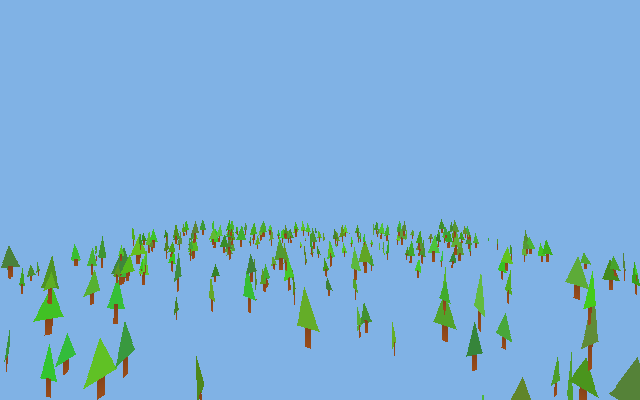
A forest from one draw call. The tree is twelve vertices written by hand in the document, a brown trunk quad and two green triangles; 400 instance records (position, scale, rotation, tint) are seeded once on the GPU; the vertex shader places each copy, tints its foliage from the record, and sways the upper vertices with a wind term. A depth buffer sorts near trees in front of far ones against a sky-blue clear.
; Instanced trees: 400 low-poly trees (a brown trunk quad plus two foliage; triangles) scattered over a ground plane, swaying in the wind, depth-tested.; A compute `(init …)` fills the per-instance buffer once (position, scale,; rotation, green tint), read by the render pass at a 32-byte instance stride.; The tree mesh is a hand-authored 12-vertex float array uploaded; a `:data` fill; the pass draws it with a two-buffer vertex layout; (`:step-mode instance`) and an expression-valued `:instance-count`. The; depth24plus texture is sized `canvas` so it always matches the colour target.; No `(primitive …)` form: the triangle-list defaults are what it needs.
(define :name NUM_TREES :value 400)
; Tree mesh: trunk quad (6 verts, brown) + two foliage triangles (6 verts,; zeroed color → the vertex shader substitutes the per-instance tint).; 12 vertices × (localPos: vec3 + localColor: vec3), arrayStride 24.(data :name treeMesh :float32 [  -0.05 0.0 0.0    0.6 0.3 0.1  0.05 0.0 0.0     0.6 0.3 0.1  0.05 0.4 0.0     0.5 0.25 0.1  -0.05 0.0 0.0    0.6 0.3 0.1  0.05 0.4 0.0     0.5 0.25 0.1  -0.05 0.4 0.0    0.5 0.25 0.1  -0.2 0.3 0.0     0.0 0.0 0.0  0.2 0.3 0.0      0.0 0.0 0.0  0.0 0.8 0.0      0.0 0.0 0.0  -0.15 0.45 0.0   0.0 0.0 0.0  0.15 0.45 0.0    0.0 0.0 0.0  0.0 0.95 0.0     0.0 0.0 0.0])
(buffer :name treeBuffer :usage [vertex]  :data treeMesh)
(buffer :name instanceBuffer :size (* NUM_TREES 8 4) :usage [vertex storage])
(buffer :name uniforms :size 16 :usage [uniform copy-dst])
(queue :name writeUniforms  (write-buffer :buffer uniforms :offset 0 :data pngine-inputs))
(init :name initTrees :buffer instanceBuffer :module initShader :workgroups [7])
(texture :name depthTexture :format depth24plus :size canvas :usage [render-attachment])
(shader-module :name renderShader :code """    struct Uniforms {      time: f32,      width: f32,      height: f32,      aspect: f32,    }    @group(0) @binding(0) var<uniform> u: Uniforms;
    struct VertexOutput {      @builtin(position) pos: vec4f,      @location(0) color: vec3f,    }
    @vertex    fn vs(      @location(0) localPos: vec3f,      @location(1) localColor: vec3f,      @location(2) instPos: vec3f,      @location(3) instScale: f32,      @location(4) instRotation: f32,      @location(5) instColorTint: vec3f    ) -> VertexOutput {      // Apply instance transform      let c = cos(instRotation);      let s = sin(instRotation);
      var pos = localPos * instScale;
      // Rotate around Y axis      let rx = pos.x * c - pos.z * s;      let rz = pos.x * s + pos.z * c;      pos = vec3f(rx, pos.y, rz);
      pos += instPos;
      // Wind sway for foliage (vertices above y=0.3)      if (localPos.y > 0.25) {        let sway = sin(u.time * 2.0 + instPos.x * 3.0) * 0.02 * (localPos.y - 0.25);        pos.x += sway;      }
      // Simple perspective projection      let z = pos.z + 3.0;      var out: VertexOutput;      // A manual divide has no near plane: a vertex at or just in front of      // the camera would project to a huge or inverted triangle. Send those      // outside the clip volume (z > w) so the rasterizer drops them.      if (z < 0.1) {        out.pos = vec4f(0.0, 0.0, 2.0, 1.0);        out.color = vec3f(0.0);        return out;      }      let projX = pos.x / z / u.aspect;      let projY = pos.y / z;      let depth = 1.0 - (z / 6.0);
      out.pos = vec4f(projX, projY, depth, 1.0);
      // Use local color for trunk, instance tint for foliage      if (length(localColor) > 0.1) {        out.color = localColor;  // Trunk      } else {        out.color = instColorTint;  // Foliage      }
      return out;    }
    @fragment    fn fs(in: VertexOutput) -> @location(0) vec4f {      return vec4f(in.color, 1.0);    }  """)
(shader-module :name initShader :code """    // 32 bytes, matching the render pipeline's instance layout (offsets 0,    // 12, 16, 20). The tint is three scalars on purpose: a `vec3f` member    // here would align to 16 and push the struct to 48 bytes, so the vertex    // stage would read padding as the tint and every third record as garbage.    struct Tree {      pos: vec3f,      scale: f32,      rotation: f32,      tintR: f32,      tintG: f32,      tintB: f32,    }    struct Trees { data: array<Tree> }
    @binding(0) @group(0) var<storage, read_write> trees: Trees;
    fn hash(n: u32) -> f32 {      var x = n;      x = ((x >> 16u) ^ x) * 0x45d9f3bu;      x = ((x >> 16u) ^ x) * 0x45d9f3bu;      x = (x >> 16u) ^ x;      return f32(x) / f32(0xffffffffu);    }
    const NUM: u32 = 400u;    const PI: f32 = 3.14159265359;
    @compute @workgroup_size(64)    fn main(@builtin(global_invocation_id) id: vec3u) {      let i = id.x;      if (i >= NUM) { return; }
      // Random position in a large area      let x = (hash(i * 7u) - 0.5) * 4.0;      let z = (hash(i * 11u) - 0.5) * 4.0 - 2.0;  // Offset back      let y = -0.5;  // Ground level
      trees.data[i].pos = vec3f(x, y, z);      trees.data[i].scale = 0.1 + hash(i * 13u) * 0.15;      trees.data[i].rotation = hash(i * 17u) * PI * 2.0;
      // Green tint variations      trees.data[i].tintR = 0.2 + hash(i * 19u) * 0.2;      trees.data[i].tintG = 0.5 + hash(i * 23u) * 0.3;      trees.data[i].tintB = 0.1 + hash(i * 29u) * 0.15;    }  """)
(render-pipeline :name renderPipeline  :layout auto  (vertex :module renderShader :entry vs    (vertex-buffer :array-stride 24 :step-mode vertex      (attribute :shader-location 0 :offset 0 :format float32x3)      (attribute :shader-location 1 :offset 12 :format float32x3))    (vertex-buffer :array-stride 32 :step-mode instance      (attribute :shader-location 2 :offset 0 :format float32x3)      (attribute :shader-location 3 :offset 12 :format float32)      (attribute :shader-location 4 :offset 16 :format float32)      (attribute :shader-location 5 :offset 20 :format float32x3)))  (fragment :module renderShader :entry fs    (target :format preferred-canvas-format))  (depth-stencil :format depth24plus :depth-write-enabled true :depth-compare less))
(bind-group :name uniformsBindGroup :layout renderPipeline :group 0  (entry :binding 0 :buffer uniforms))
(render-pass :name mainPass  (color-attachment :view context-current-texture :clear-value [0.5 0.7 0.9 1] :load-op clear :store-op store)  (depth-stencil-attachment :view depthTexture :depth-clear-value 1.0 :depth-load-op clear :depth-store-op store)  :pipeline renderPipeline  :vertex-buffers [treeBuffer instanceBuffer]  :bind-groups [uniformsBindGroup]  (draw :vertex-count 12 :instance-count NUM_TREES))
(frame :name main :init [initTrees] :perform [writeUniforms mainPass])examples/samples/16_instanced_trees.sjon in the pngine repository.
How it works
Section titled “How it works”A hand-authored mesh
Section titled “A hand-authored mesh”The tree is typed into the document as a form of SJON, the S-expression
format pngine compiles, where each form is one WebGPU resource or
operation. (data :name treeMesh :float32 [ … ]) is twelve rows of
x y z r g b:
six vertices for the trunk quad (two triangles, brown) and six for two
foliage triangles whose colour is zeroed. That zero is a signal: in vs
(the vertex stage’s WGSL, WebGPU’s shading language),
if (length(localColor) > 0.1) keeps the trunk’s own colour and otherwise
substitutes the instance’s green tint, so one mesh serves 400 differently
coloured trees. treeBuffer is filled at creation from it with :data,
which also gives the buffer its size, and the pipeline’s first
(vertex-buffer …) reads it at :array-stride 24 into @location(0) and
@location(1).
400 instances from a compute pass
Section titled “400 instances from a compute pass”instanceBuffer is NUM_TREES × 8 floats with [vertex storage] usage.
(init :name initTrees :buffer instanceBuffer :module initShader :workgroups [7])
runs initShader once, before the first frame: 7 workgroups × 64 threads =
448 slots, and the shader returns early past index 399. Each record is a
hashed position on the ground plane (y = -0.5, pushed back), a scale, a
rotation and a green tint with hashed variation. The pipeline’s second
(vertex-buffer …) is :step-mode instance at a 32-byte stride,
@location(2) to @location(5) at offsets 0, 12, 16 and 20, and the WGSL
Tree struct lays out to exactly those bytes. I lay the tint out as three
scalars on purpose, and the comment in the shader says why. This is the
struct as written:
Tree with the tint as three f32 scalars: 32 bytes, matching the stride
byte    0      4      8      12     16     20     24     28     32        |pos.x |pos.y |pos.z |scale | rot  |  tR  |  tG  |  tB  |
And this is what a single vec3f tint would do to it:
Tree with tint: vec3f: the tint aligns to 16, the struct pads to 48
byte    0      4      8      12     16     20                 32     36     40     44     48        |pos.x |pos.y |pos.z |scale | rot  |       (pad)      |  tR  |  tG  |  tB  |(pad) |
The vertex layout would still read 32-byte records with the tint at byte
20, so it would read padding as colour and fall sixteen bytes further out
of step with every tree. When a compute shader writes what a vertex layout
reads, the two descriptions of the bytes have to agree.
(draw :vertex-count 12 :instance-count NUM_TREES) draws all 4800
vertices at once.
Wind and depth
Section titled “Wind and depth”vs scales, rotates about y and translates each vertex by its instance
record, then, for vertices with localPos.y > 0.25 (the foliage), adds a
sideways sway sin(2t + 3x) · 0.02 · (y - 0.25) that grows with height,
so the crowns wave and the trunks stand still. It projects with a manual
perspective divide (z + 3, x / z / aspect) and writes 1 - z / 6 as
the depth. A hand-rolled divide has no near plane, and about a quarter of
the trees stand at or behind the camera; a vertex there would project to
a huge or inverted triangle, so vs sends any vertex with z < 0.1 to
(0, 0, 2, 1), outside the clip volume, and the rasterizer drops it.
(depth-stencil :format depth24plus :depth-write-enabled true :depth-compare less)
and the canvas-sized depthTexture do the sorting; I set no culling,
since a triangle seen from behind should still count as a tree.
An exercise: delete the if (z < 0.1) guard from vs and recompile. Every
tree standing at or behind the camera now projects to a huge or inverted
triangle slashing across the sky; the guard was the near plane, hand-rolled,
and this is the picture without one.
The rest
Section titled “The rest”The uniform buffer refilled every frame from pngine-inputs (the built-in
time/width/height/aspect source), the bind group and the frame with
its :init list follow the pattern of
Multiple triangles.
In the specifications
Section titled “In the specifications”| What the sample uses | WebGPU | WGSL |
|---|---|---|
| Instanced draw from two buffers | draw(), GPUVertexStepMode, vertex state |
@location inputs |
| Depth testing without culling | depth/stencil state, depth/stencil attachments, GPUCullMode |
|
| One-shot compute seeding | compute pipelines, dispatchWorkgroups() |
@workgroup_size, global_invocation_id, structure member layout |
| Buffer with two usages | buffer usage, mappedAtCreation |
storage address space |
| Near-plane guard | primitive clipping, clip space coordinates | return statement |
| Wind and colour selection | sin, length, if statement |
Related
Section titled “Related”- Multiple triangles is the same instancing pattern in 2D; Multiple objects adds lighting and culling.
- Forms:
(data …),(init …),(texture …),(render-pipeline …).