Diffusion
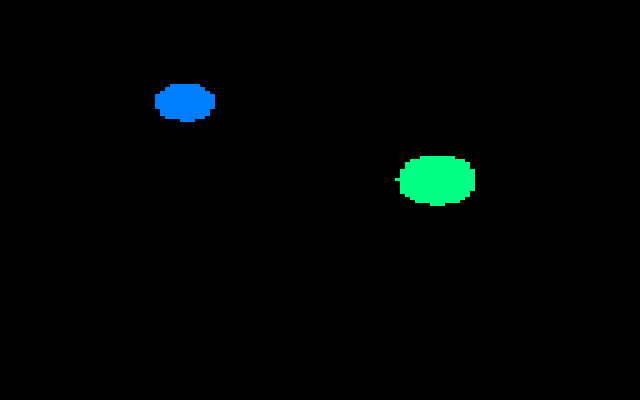
The heat equation on a grid. Two warm spots wander across a 128×128 field; each frame a compute shader replaces every cell with itself plus a fraction of the difference from its four neighbours (the discrete Laplacian), decays it slightly, and clamps it. A fullscreen triangle then maps the temperature through a five-stop colour ramp. The picture you see before Play is the first frame; press Play and the trails develop.
; Diffusion. Heat spreading over a 128×128 field: two moving sources inject; heat, a compute pass applies the discrete Laplacian with decay each frame,; and a fullscreen triangle colour-maps the field (black → blue → cyan → green; → yellow → red). Same structure as 17_game_of_life: a compute `(init …)`; zeroes the `:pool 2` ping-pong buffer once, the step bind group has three; entries (uniforms + heat in/out with `:ping-pong`), passes select the variant; with `:bind-groups-pool-offsets`, `(dispatch :workgroups [8 8 1])` over a 16×16 workgroup,; and `fs` reads the storage buffer directly.;; GRID_SIZE sizes the buffer only; each shader restates the extent as a local; `SIZE` constant. Keep them in step.
(define :name GRID_SIZE :value 128)
(buffer :name heatBuffer :size (* GRID_SIZE GRID_SIZE 4) :usage [storage] :pool 2)
(buffer :name uniforms :size 16 :usage [uniform copy-dst])
(queue :name writeUniforms  (write-buffer :buffer uniforms :offset 0 :data pngine-inputs))
; Zero the heat field once.(init :name initHeat :buffer heatBuffer :module initShader :workgroups [(ceil (/ (* GRID_SIZE GRID_SIZE) 64))])
(shader-module :name initShader :code """struct Heat { data: array<f32> }@binding(0) @group(0) var<storage, read_write> heat: Heat;
const SIZE: u32 = 128u;
@compute @workgroup_size(64)fn main(@builtin(global_invocation_id) id: vec3u) {  let idx = id.x;  if (idx >= SIZE * SIZE) { return; }  heat.data[idx] = 0.0;}""")
(shader-module :name stepShader :code """struct Uniforms {  time: f32,  width: f32,  height: f32,  aspect: f32,}@group(0) @binding(0) var<uniform> u: Uniforms;
struct Heat { data: array<f32> }@group(0) @binding(1) var<storage, read> heatIn: Heat;@group(0) @binding(2) var<storage, read_write> heatOut: Heat;
const SIZE: u32 = 128u;const DIFFUSION: f32 = 0.2;const DECAY: f32 = 0.995;
fn getHeat(x: i32, y: i32) -> f32 {  if (x < 0 || x >= i32(SIZE) || y < 0 || y >= i32(SIZE)) {    return 0.0;  }  return heatIn.data[u32(y) * SIZE + u32(x)];}
@compute @workgroup_size(16, 16)fn main(@builtin(global_invocation_id) id: vec3u) {  if (id.x >= SIZE || id.y >= SIZE) { return; }
  let x = i32(id.x);  let y = i32(id.y);  let idx = id.y * SIZE + id.x;
  // Laplacian (heat diffusion)  let center = getHeat(x, y);  let neighbors = getHeat(x-1, y) + getHeat(x+1, y) +                  getHeat(x, y-1) + getHeat(x, y+1);  let laplacian = neighbors - 4.0 * center;
  var newHeat = center + DIFFUSION * laplacian;
  // Add heat source (moving circle)  let cx = f32(SIZE) / 2.0 + sin(u.time) * f32(SIZE) * 0.3;  let cy = f32(SIZE) / 2.0 + cos(u.time * 0.7) * f32(SIZE) * 0.3;  let dist = length(vec2f(f32(id.x) - cx, f32(id.y) - cy));  if (dist < 8.0) {    newHeat += 0.5;  }
  // Second source  let cx2 = f32(SIZE) / 2.0 + sin(u.time * 1.3 + 2.0) * f32(SIZE) * 0.25;  let cy2 = f32(SIZE) / 2.0 + cos(u.time * 0.9 + 1.0) * f32(SIZE) * 0.25;  let dist2 = length(vec2f(f32(id.x) - cx2, f32(id.y) - cy2));  if (dist2 < 6.0) {    newHeat += 0.3;  }
  newHeat *= DECAY;  heatOut.data[idx] = clamp(newHeat, 0.0, 1.0);}""")
(compute-pipeline :name stepPipeline :layout auto (compute :module stepShader :entry main))
(bind-group :name stepBindGroup :layout stepPipeline :group 0 :pool 2  (entry :binding 0 :buffer uniforms)  (entry :binding 1 :buffer heatBuffer :ping-pong 0)  (entry :binding 2 :buffer heatBuffer :ping-pong 1))
(compute-pass :name stepPass  :pipeline stepPipeline  :bind-groups [stepBindGroup]  :bind-groups-pool-offsets [0]  (dispatch :workgroups [8 8 1]))
(shader-module :name renderShader :code """struct Heat { data: array<f32> }@group(0) @binding(0) var<storage, read> heat: Heat;
struct Uniforms {  time: f32,  width: f32,  height: f32,  aspect: f32,}@group(0) @binding(1) var<uniform> u: Uniforms;
const SIZE: f32 = 128.0;
@vertexfn vs(@builtin(vertex_index) i: u32) -> @builtin(position) vec4f {  let x = f32(i & 1u) * 4.0 - 1.0;  let y = f32((i >> 1u) & 1u) * 4.0 - 1.0;  return vec4f(x, y, 0.0, 1.0);}
fn heatColor(t: f32) -> vec3f {  // Black -> Blue -> Cyan -> Green -> Yellow -> Red  if (t < 0.2) { return mix(vec3f(0.0, 0.0, 0.0), vec3f(0.0, 0.0, 1.0), t / 0.2); }  if (t < 0.4) { return mix(vec3f(0.0, 0.0, 1.0), vec3f(0.0, 1.0, 1.0), (t - 0.2) / 0.2); }  if (t < 0.6) { return mix(vec3f(0.0, 1.0, 1.0), vec3f(0.0, 1.0, 0.0), (t - 0.4) / 0.2); }  if (t < 0.8) { return mix(vec3f(0.0, 1.0, 0.0), vec3f(1.0, 1.0, 0.0), (t - 0.6) / 0.2); }  return mix(vec3f(1.0, 1.0, 0.0), vec3f(1.0, 0.0, 0.0), (t - 0.8) / 0.2);}
@fragmentfn fs(@builtin(position) pos: vec4f) -> @location(0) vec4f {  let cellX = u32(pos.x * SIZE / u.width);  let cellY = u32(pos.y * SIZE / u.height);  let idx = cellY * u32(SIZE) + cellX;
  if (idx >= u32(SIZE * SIZE)) {    return vec4f(0.0, 0.0, 0.0, 1.0);  }
  let h = heat.data[idx];  return vec4f(heatColor(h), 1.0);}""")
(render-pipeline :name renderPipeline  :layout auto  (vertex :module renderShader :entry vs)  (fragment :module renderShader :entry fs    (target :format preferred-canvas-format)))
(bind-group :name renderBindGroup :layout renderPipeline :group 0 :pool 2  (entry :binding 0 :buffer heatBuffer :ping-pong 1)  (entry :binding 1 :buffer uniforms))
(render-pass :name drawPass  (color-attachment :view context-current-texture :clear-value [0 0 0 1] :load-op clear :store-op store)  :pipeline renderPipeline  :bind-groups [renderBindGroup]  :bind-groups-pool-offsets [0]  (draw :vertex-count 3))
(frame :name main :init [initHeat] :perform [writeUniforms stepPass drawPass])examples/samples/18_diffusion.sjon in the pngine repository.
How it works
Section titled “How it works”The structure is exactly that of Game of Life, with a continuous field instead of binary cells: the same SJON forms (the S-expression format pngine compiles, one form per WebGPU resource or operation) around different WGSL, WebGPU’s shading language. That page explains the ping-pong machinery in more detail.
The field
Section titled “The field”(buffer :name heatBuffer :size (* GRID_SIZE GRID_SIZE 4) :usage [storage] :pool 2)
is one f32 per cell, allocated twice: :pool 2 gives the buffer two
variants so a pass can read one and write the other. (init :name initHeat … :workgroups [(ceil (/ (* GRID_SIZE GRID_SIZE) 64))])
zeroes it once before the first frame with a compute shader over
16384 / 64 = 256 workgroups. As on the other simulation pages, the
(define …) value sizes the buffer only and each shader restates the
extent as const SIZE.
The step
Section titled “The step”stepShader binds the uniforms plus heatIn (storage, read) and
heatOut (storage, read_write). Per cell:
laplacian = (left + right + up + down) - 4 · center, withgetHeatreturning 0 outside the grid (a cold boundary, unlike the wrap-around in Game of Life);newHeat = center + DIFFUSION · laplacian, withDIFFUSION = 0.2, which I keep comfortably under the 0.25 stability limit of this explicit scheme (an exercise: nudge it past 0.25 in your own copy of the source, recompile and play it; the limit is not theoretical);- two sources add heat inside moving discs of radius 8 and 6, whose centres
are sines and cosines of
u.timeat different rates; newHeat *= DECAY(0.995) andclamp(newHeat, 0, 1).
(compute-pass :name stepPass … :bind-groups-pool-offsets [0] (dispatch :workgroups [8 8 1]))
runs it over 8 × 8 workgroups of 16 × 16 threads. The bind group is
:pool 2 with :ping-pong 0 on heatIn and :ping-pong 1 on heatOut;
the runtime advances the offset every frame, so this frame’s output is next
frame’s input.
The display
Section titled “The display”renderShader draws the fullscreen triangle and, per pixel, reads the cell
under it (renderBindGroup binds heatBuffer :ping-pong 1, the variant
just written) and maps it with heatColor: five mix segments,
black → blue → cyan → green → yellow → red, over [0, 1]. Nothing is
uploaded or copied between the compute and render passes; both bind the same
GPU buffer.
In the specifications
Section titled “In the specifications”| What the sample uses | WebGPU | WGSL |
|---|---|---|
| Storage buffer shared by compute and fragment stages | GPUBufferUsage.STORAGE, bind group creation |
storage address space, access modes, runtime-sized arrays |
| Compute pass over a 2D grid | compute passes, dispatchWorkgroups() |
@workgroup_size, global_invocation_id |
| Fullscreen triangle reading the field | draw() |
vertex_index, position |
| Time for the sources | writeBuffer() |
uniform address space, sin / cos |
| The arithmetic | clamp, length, mix, const declarations, if statement |
Related
Section titled “Related”- Game of Life (same structure, binary cells), Wave simulation (second-order in time), Fluid simulation (two fields).
- Forms:
(buffer …)(:pool),(bind-group …)(:ping-pong),(compute-pass …),(init …).